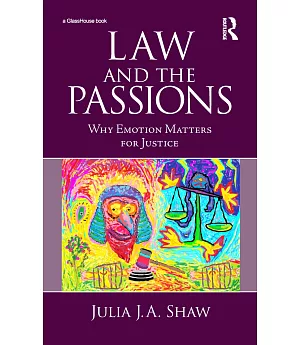
Although the connection of law, passion and emotion has become an established focus in legal scholarship, the extent to which emotion has always been, and continues to be, a significant influence in informing legal reasoning, decision-making, decision-avoidance and legal judgment – rather than an adjunct – is still a matter for critical analysis. Engaging with the underlying social context in which emotional states are a motivational force – and have produced key legal principles and controversial judgments, as evidenced in a range of illustrative legal cases – Law and the Passions: A Discrete History provides a uniquely inclusive commentary on the significance and influence of emotions in the history and continuing development of legal institutions and legal dogma. Law, it is argued, is a passion; and, as such, it is a primarily emotional endeavour.
-
The Edinburgh Dictionary of Modernism
$10,350 -
William T. Vollmann: Writing America’s Other Histories
$4,725 -
Edinburgh Companion to Scottish Traditional Literatures: Border Country
$5,400 -
Classical Philosophers on Literature: Plato, Aristotle, Longinus
$1,213 -
Samuel Johnson: Samuel Johnson
$6,075 -
Critical Practice: Theorists and Creativity
$1,033 -
Textual Scholarship: An Introduction
$5,850 -
Modernism, Internationalism and the Russian Revolution
$5,400 -
Hearing Voices: Aurality and New Spanish Sound Culture in Sor Juana Inés De La Cruz
$2,700 -
A Manifesto for Literary Studies
$4,050 -
Introducing Electronic Literature
$1,573 -
The Timelessness of Proust
$595 -
The Edinburgh Dictionary of Modernism
$1,800 -
The Aesthetics of Children’s Poetry: A Study of Children’s Verse in English
$6,748 -
Literature, Science and Religion in Constantijn Huygens’ Ooghentroost
$6,748 -
The Canon
$4,950 -
The Purple Decades: A Reader
$350 -
Literature of the 1970’s: Things Fall Apart
$5,400 -
Ian Mcewan
$898 -
Mendacity and the Figure of the Liar in Seventeenth-Century French Comedy
$6,300